


The Indo-Canadian community’s journey from exclusion to empowerment was carved through the forestry industry of British Columbia. Their right to vote was removed in 1907 and they fought continuously for 40 years to win it back. Part of this fight came from the bottom up. Darshan Singh Sangha rose from a sawmill’s ‘green chain’ to the front steps of the Victoria legislature through his work with the International Woodworkers of America. He managed to unite the Indo-Canadian community with the labour movement—a feat that would seem unlikely at the beginning of the 20th century. Sangha’s ability to change hearts in the lumber industry would go on to change the face of Canadian society.
At the beginning of the 20th century, the hearts of white labourers were decidedly hardened against South Asian immigrants. Their competition for labour was fierce. Bosses could pay Asian workers a fraction of what they paid white workers for the same quality of work, creating resentment between workers. Their resentment was intensified by racist policies that were introduced by the provincial and federal governments, who sought to act on their community’s aggravations.
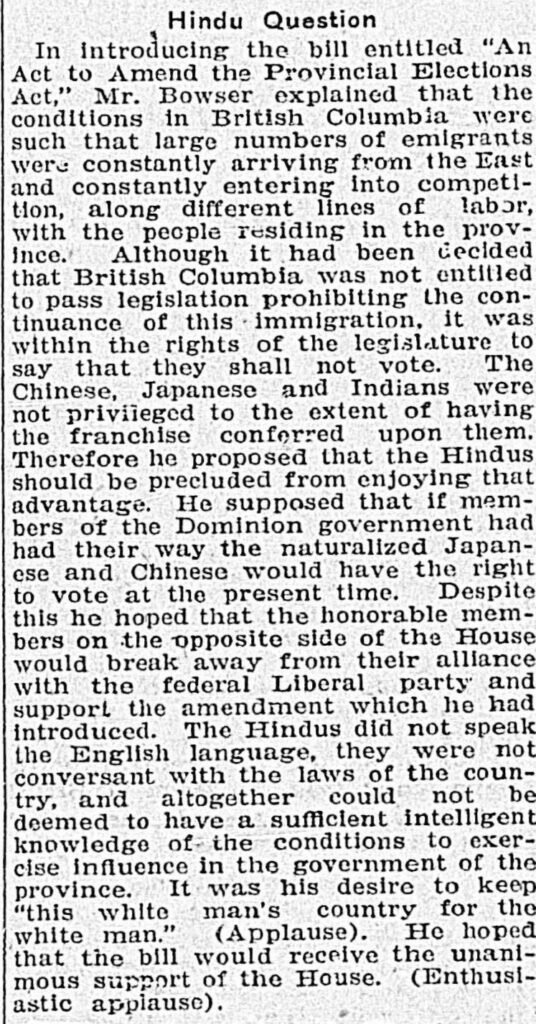
Over 90% of the South Asian immigrants who arrived were Sikh. In the broader Empire, they were known for their honourable service in the British Army while in Canada, they were nearly unknown. With their long beards and turbans, they did not fit a white nationalist image of what a Canadian should look like. BC took away the right to vote from South Asians on March 26, 1907 with the expressed purpose of “keep the white man’s country for the white man.” The amendment passed unanimously with “enthusiastic applause.” Only those who could vote provincially could vote federally, so South Asian British Columbians were completely disenfranchised at every level. Officially excluding South Asian immigrants was a dangerous signal to send to discontented white workers.
Emboldened, the Vancouver and Victoria Trades and Labour Councils supported the formation of the discriminatory Asiatic Exclusion League. This group caused thousands of dollars in damage to Asian businesses in Vancouver that September in protest of Asian immigration. The Canadian government supported their aims and passed legislation making it incredibly difficult for people to immigrate from India. It was clear that the political and social landscape of BC was intent on excluding South Asians.
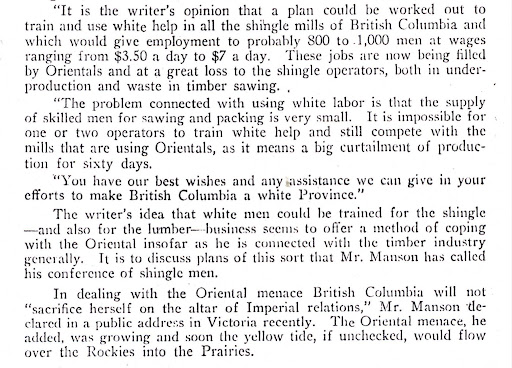
Meanwhile, the economic landscape of BC was being logged and milled by Asian workers. They dominated the lower rungs of the sawmills and even began to break into the higher ranks. In 1922, one lumber producer was struggling to replace 800-1000 Asian labourers in his shingle-making mill. No matter how badly he wanted to do so, pivoting to an all-white workforce would cost too much time and money. Underpaying (or refusing to pay) Asian workers was good for business. So good, in fact, that the ability to grow and manage an Asian workforce became an asset in forestry. Some Asian business owners rose to the very top partially due to their networks and shared language with their workforce.
Case in point: Darshan Singh Sangha, a Sikh from British India, arrived in Canada in 1937 to work at a sawmill owned by Kapoor Singh Siddoo, a fellow Sikh from British India. Sangha used his wages to sustain him as he pursued a degree at the University of British Columbia. He grasped political concepts with ease, leading him to join the Young Communist League. On the other side, Kapoor managed to own his own lumber company despite Asians being prohibited from holding logging licenses. Six logging companies, Seven camps, and two shingle mills were owned by South Asian immigrants by 1922. 609 out of 680 South Asians in Canada were employed in the lumber industry. Kapoor, Sangha, and other South Asians thus found success in Canadian society despite the exclusion they faced.
Sangha’s success in Canada was frustrated by the sudden loss of his work permit. His employers were informed and he could not remain at the mill. With no income, he could not afford to stay in university or return home. He worked the night shift on the green chain, sorting lumber at an Albertan sawmill. It was cold and brutal. There seemed to be little hope that Sangha would ever regain his legal status.
Sangha had officially lost his permit due to his communist ties, but the government was cracking down on Asian immigrants at the time. In 1938, South Asian immigrants were ordered to register their locations. Fearing that their workers could be deported, Mayo Singh and Kapoor Singh, hired lawyer Dr. Pandia to help secure their legal status. Dr. Pandia’s work was a ray of hope for Sangha. He could use his political fluency to organize support for his cause. He headed to Vancouver and proved to be a compelling speaker. He raised $4,000 to hire lawyers for the South Asian community. That amounts to roughly $89,263 today—a huge sum. Their collective efforts succeeded and more than 300 South Asians were given legal status in 1939.
Sangha’s proven ability to mobilize the South Asian community led the Industrial Woodworkers of America to hire him as a union organizer. The IWA’s Nigel Morgan explained their problem to Sangha. They were successful on the mainland, but organizing on Vancouver Island failed to take off. The largely Sikh workforce were resistant to unions. Unionizing was an alien concept to them, which threatened retribution from their bosses. Familial and regional loyalties to their bosses also persuaded them to stay quiet. But without their support, any union formed among white workers would surely be undercut. The IWA desperately needed Sangha to reach South Asian workers.
Sangha’s rhetorical strategy proved incredibly effective in the specific climate of BC during the Second World War. Sangha identified two developments in this period which he capitalized upon. Firstly, South Asians had gained immense bargaining power in this period. Japanese lumber workers had been interned, making it difficult to replace lower-level workers. Furthermore, 30 forestry companies of about 200 men each were created to harvest and mill timber in Europe for use in camp construction. Men with experience in the lumber industry were preferred for the Canadian Forestry Corps, sapping the amount of white labourers in Canada. Many South Asians protested the war effort, and thus came to form a substantial amount of the domestic lumber workforce. They could no longer be fired at the drop of a hat. Fighting for labour rights was less intimidating now.
The second factor was that the labour movement at this time allied with global anti-imperialist notions of freedom. By bundling South Asian rights and Indian independence with his organizing, Sangha could win the hearts of Sikh workers that were disenfranchised both in Canada and India. South Asian immigrants fled injustice as minorities in India to seek better lives in Canada. The struggle for Indian Independence was reaching a fever pitch during WWII, and Indian emigrants felt a drive to fight for freedom wherever they were. Emphasizing this ability and motivation to seek justice allowed Sangha to shake South Asian labourers out of their fear and into action.
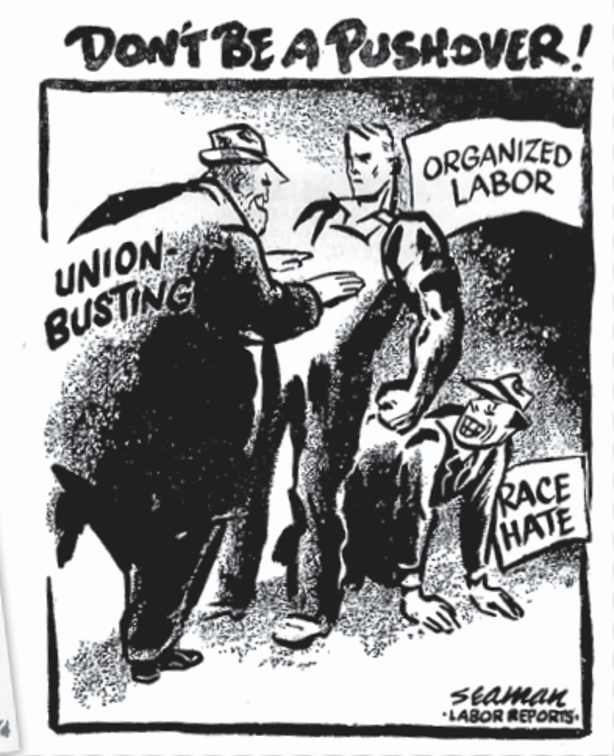
Canadian Congress of Labour, Canadian Labour Reports,
pamphlet, BC Labour Heritage Centre files in Union Zindabad! Pg 58.
One of his most famous successes happened at a sawmill in Youbou. The owner of the mill found his workers in their bunkhouse, talking to Sangha about joining the IWA. Furious, he drove Sangha off the site himself. When the owner came back to the mill, more than ninety workers were standing outside in the pouring rain, promising to leave if Sangha did not return. The owner was forced to drive Sangha back to the bunkhouse to continue his meeting. Word of this triumph spread quickly in BC, and Sangha racked up unionizing wins with Sikh workers. The rising star ended up becoming the recording secretary and a Trustee in the Victoria IWA district council, one of the first men of colour to hold such a post.
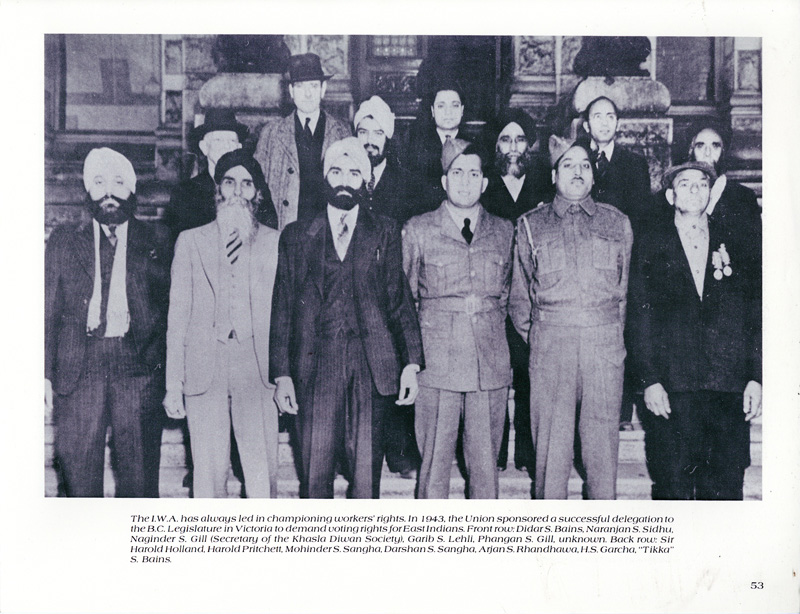
To make good on Sangha’s promises of freedom for South Asian Canadians, the IWA supported the delegation shown in this photograph. On March 1, 1943, IWA president Harold Pritchett accompanied Sangha on a Khalsa Divan Society delegation to demand the vote at the BC legislature. The Khalsa Divan Society was a Sikh community organization dedicated to the social and economic development of Sikhs in North America. Naginder Singh Gill led the delegation, backed by Society leaders Naranjan Singh, Harnam Singh Garcha, Didar S. Bains, Arjan Singh, and Mohinder Singh. Sir Robert Holland, a former British administrator in India, also accompanied them. The IWA, Khalsa Divan Society, and Sir Holland formed the establishment core of the delegation. Their presence disputed the notion that South Asians were not productive and thriving members of Canadian society.
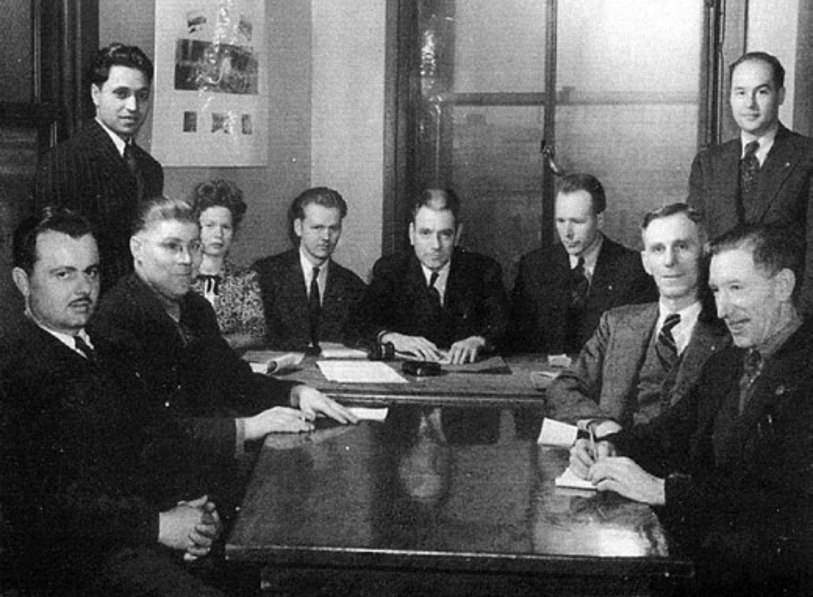
The other part of the delegation challenged the notion that South Asian Canadians were not loyal and patriotic by emphasizing their military service. South Asians had protested conscription without representation while still desiring to prove their loyalty to Canada. The Vancouver Daily Province summarized this issue on October 13, 1942 as follows:
“The East Indians have some very good arguments. They are British subjects, they point out. They say they are loyal, and in the absence of the slightest evidence to the contrary it must be assumed they are. They insist that they would be happy to serve Canada in any way possible if admitted to citizenship. Some of them, though without citizenship rights, are subject to the draft, and they regard that as hardly fair…. East Indians have been seeking the franchise in this province since 1908. If it is ever to be granted; now, while it can be employed to great political advantage, is the right moment.”
Instead of granting them their rights, the Canadian government elected to exempt South Asians from conscription. This move disappointed South Asians and galvanized support for them among the greater British Columbian community. Politicians and citizens lamented that their men fought Nazi racism abroad while discriminating against South Asians at home. Harold Winch, leader of the Canadian Commonwealth Federation (a predecessor of today’s NDP), reflected these sentiments at the Khalsa Divan Society ahead of the 1943 delegation. In front of 1,200 allies of the movement at Vancouver’s Orpheum Theatre, he declared that:
“When history is written, this will be known as the age of hypocrisy. It will be written that while we boasted of civilization, we practiced barbarism. While we talked of the brotherhood of man, we practiced racial prejudice. We are hypocrites if we say that the people of India cannot have the freedom for which we are fighting ourselves.”
Some South Asians enlisted regardless of their exemption from conscription. Bikram Berar recalled his father enlisting in Duncan, insisting that:
“This is the country we chose; it’s part of the British Commonwealth and we will continue to negotiate until we do get our actual right to vote.”
Representing loyal Indo Canadians like Mr. Berar was important to the 1943 delegation. Present at the delegation were Phangan Gill and G.S. Badal, recently discharged members of the Armed Forces. Veteran Bahu Singh attended and displayed his WWI medals. The South Asian community also purchased Victory Bonds that would total $496,570 by the end of the War. By putting their lives and livelihoods on the line for Canada, South Asian Canadians proved their ultimate loyalty in a bid for equality.
Their message was summarized in Naginder Singh Gill’s address to Premier John Hart:
“We have tried conscientiously to fulfil the duties and responsibilities of citizenship, but we have been denied the democratic rights of that citizenship. We contend that the denial of these rights is without justification in logic or reason. … We are a people of an old and democratic tradition. We believe in and are prepared to fight for principles and liberties of democracy. … We want our children to grow up as good Canadians and responsible citizens.”
Unfortunately, Premier Hart refused to act on the issue until WWII was over. Attorney General Maitland continued to hold this line in 1944 when South Asian Canadians argued for the vote once more. Sangha emphatically refuted this logic, saying:
“Mr. Maitland contends that the boys overseas may disapprove (of) East Indian enfranchisement at this time. Those boys are giving their lives to extend that same freedom to the people of Europe, which the East Indians are demanding at home. Freedom, like charity, begins at home. Canadian democracy will not suffer but will gain with the extension of democratic rights to a people who, too, are a part of the Commonwealth.”
The delegation failed to win the vote, but the momentum that Sangha helped build was unstoppable. Uniting the labour rights and South Asian rights movements decisively empowered both communities. Sangha and the IWA were backed by the Canadian Commonwealth Federation in linking the two social movements. Eventually, 72 other unions and MLAs followed the IWA’s lead in publicly demanding the vote for Asian Canadians. The tide had officially turned. In 1907, the government was enacting discriminatory laws against South Asians to appease angered white unions. By 1943, the now-integrated unions of BC stood up for the Asian community as their brothers. A monumental shift like this was possible through the hard work of South Asians like Sangha in the lumber industry.
Kimberley Hadford
Multi-racial union activism formed one half of the effort to win back the vote for Asians in Canada. Forestry workers had built up steam for the movement, but more investment from the lumber barons was required to regain the vote in 1947. Check out Part 2 of our Labour Day series to read about Mayo Singh, Kapoor Singh, and their crucial contributions to the fight for the vote!
Selected Bibliography for Part I
Bains, Satwinder Kaur, and Balbir Gurm, eds. A Social History of South Asians in British Columbia. Abbotsford, BC: The South Asian Studies Institute, University of the Fraser Valley, 2022.
Garden, Bailey, Donna Sacuta, and Dr. Anushay Malik. Union Zindabad! South Asian Canadian Labour History in British Columbia. Abbotsford, BC: The South Asian Studies Institute, University of the Fraser Valley, 2022.
Hundal, Sukhwant and Sadhu Binning. “How Indians Lost and Finally Won Back the Right to Vote in Canada.” Sukhwant Hundal, April 3, 2025, https://sukhwanthundal.wordpress.com/2025/04/03/how-indians-lost-and-finally-won-back-the-right-to-vote-in-canada/
Jagpal, Sarjeet Singh. Becoming Canadian: Pioneer Sikhs in Their Own Words. Madeira Park: Harbour Publishing, 1994.
Victoria Times Colonist. “East Indians ask for the Elimination of Racial Barriers: Delegation Seeks Vote in Province” March 3, 1943, pp. 10. https://archive.org/details/dailycolonist0343uvic_0/page/n9/mode/1up?q=vote
“The Hindu Question” The Victoria Daily Colonist, March 27, 1907, pp. 2.
“Would Eliminate Orientals” The Western Lumberman, July 1922.

